Welcome!

This is a blog of the 4th grade class in la Farigola de Vallcarca School in Barcelona. This year we are doing “Aula de Ciències” in English.
In this blog we want to show you the experiments we do in our Science Lab. Science is fun!


dimecres, 6 d’octubre del 2010

Jumping egg

MATERIALS:
Two glasses
Two eggs
Vinegar
Water
INSTRUCTIONS:
- Fill a glass with water and put one egg into it.
- Fill the second glass with vinegar and put another egg in.
- Wait three or four days.
- The egg in vinegar hasn't got a shell. It's bigger and darker than the egg in water.
WHY:
Vinegar is an acid and dissolves the calcium in the eggshell. It is calcium that makes the shell hard. A thin flexible membrane just under the shell still holds the egg's shape.
Water does nothing to the eggshell.

divendres, 9 d’abril del 2010

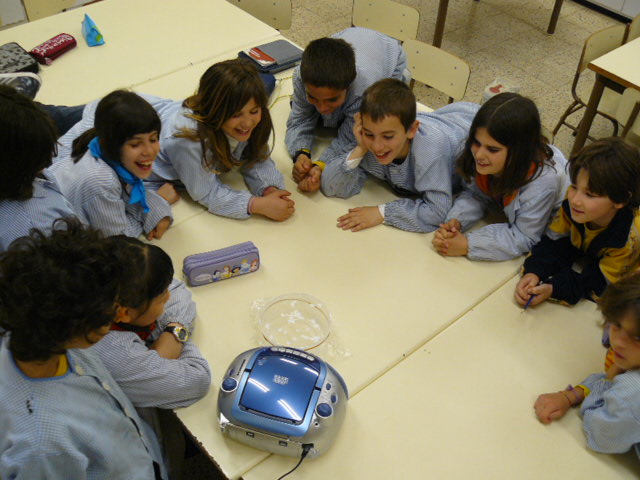
Discopaper

Materials: - A bowl - An elastic band - Plastic film - Toilet paper - A radio Instructions: Stretch a piece of plastic film across the top of the bowl. Lay tiny pieces of toilet paper on. Place the bowl next to the radio. Turn on the radio. Turn up the volume. The toilet paper starts to move. Why: The sound from the radio makes air vibrate. If the music is very loud, vibrations are stronger. Vibrations make the plastic film vibrate, so the tiny pieces of toilet paper move too. Different styles of music have different speeds of vibration.

dijous, 4 de març del 2010

Paper chromatography

MATERIALS Paper towel Red, yellow and blue food colouring 1 glass Spoon Water Scissors An eye-dropper Water INSTRUCTIONS Drop one drop of red, one drop of yellow, and one drop of blue food colouring together on a glass. Mix the three drops together and observe the mixture. Cut a 3 cm strip of paper towel. Using the eye-dropper put a small drop of the food colour mixture in the centre of the paper towel strip about 3 cm from one end. Fill the other glass with water. Place the end of the paper towel strip with the food colouring dot into the water. Make sure the water does not touch the food colouring. Observe for 5-10 minutes. The water separates the food colouring mixture with separate portions of red, blue and yellow on the paper towel strip. WHY? Because the water creeps along the surface of the paper and dissolves the particles of colour. The components of the mixture move along the paper. The different colours do not move at the same speed because they all have different attractions to solvent and paper. WHAT DO YOU THINK ABOUT IT? WRITE YOUR OPINIONS!

dimarts, 23 de febrer del 2010

Magnetic pick up

MATERIALS: A strong magnet A paper clip Thread A piece of paper Clear tape Scissors Crayons
INSTRUCTIONS: Draw a kite and a rectangle in a piece of paper. Colour and cut them out. Put a paper clip on one corner of the kite. Tape a piece of thread to the opposite corner. Tape the other end of the thread to the rectangle. Tape the rectangle to a table. Hold the kite between your fingers and move the magnet away from the paper clip. The kite “flies”.
WHY?
Because a paper clip is made of metal and magnets have a magnetic field that attracts some kinds of metal. The paper clip does not have to touch the magnet to be pulled by magnetism.
WHAT DO YOU THINK ABOUT IT? WRITE YOUR COMMENTS.

dijous, 4 de febrer del 2010

Make a lava lamp

MATERIALS: -Food colouring. -Cooking oil -A plastic bottle -A funnel -Salt -Water
INSTRUCTIONS: 1. Put some water into the plastic bottle. 2. Add six drops of food colouring to the water. 3. Add a small quantity of cooking oil into the plastic bottle using a funnel. The cooking oil forms a layer on top of the water. 4. Mix everything. 5. Add some salt into the water. 6. Watch closely.
WHY? Oil and water don't mix because water is heavier. Oil makes a layer on the surface of the water. The salt sinks to the bottom and takes some oil with it. The salt dissolves in the water. Then, the oil floats back up to the surface.
WHAT DO YOU THINK ABOUT? WRITE YOUR COMMENTS.

dijous, 21 de gener del 2010

Fizzy Fun

Materials: Vinegar 2 glasses A piece of chalk (it is made of limestone) Several different rock types and minerals A magnifying glass

Instructions: - Pour a glass of vinegar into a glass. - Add a small piece of chalk (it is made of limestone). - Watch closely. After a few minutes, the piece of chalk starts to fizz. - Put another glass of vinegar into the other glass. - Put some different rock types and minerals into that glass (some of them contain limestone). - Watch closely. After a few minutes, some of them start to fizz and we can see bubbles.

WHY? Because vinegar is an acid and it dissolves small particles of calcium carbonate in the limestone (a mineral). We can see bubbles, because it releases carbon dioxide, a gas that rises to the surface. Rocks or minerals that contain calcium carbonate fizz. Those that don’t contain calcium carbonate won’t fizz.

dimarts, 22 de desembre del 2009

Darwin Year. Our work.

Last week, we worked on animals and we made two poster collages using pictures the students had drawn themselves or pictures collected from magazines.
Although there are many different types of animals in the world, they can be classified into two main groups: VERTEBRATES AND INVERTEBRATES. Each group has its own characteristics:
On one hand, VERTEBRATES are animals with backbones. Vertebrates include fish, amphibians, reptiles, birds and mammals. They have the next characteristics:
-Fish:
*Breathe under water with gills
*Have fins and scales.
-Mammals:
*Covered with hair
*Warm-blooded
*Babies drink milk
*Sweat when it's hot
-Birds:
*Covered with feathers
*Lay eggs
*Migrate with the weather
-Amphibians:
*Can live on land or water
*Gills become lungs
*Born in the water
-Reptiles:
*Cold-blooded
*Born on land
*Scaly skin
*Some reptiles lay eggs
On the other hand, INVERTEBRATES are animals without a Spinal Column. The most common invertebrates include annelids, echinoderms, molluscs and arthropods.
- Annelids:
*Segmented bodies
*Have no legs
-Echinoderms:
*Live in the ocean
*Have spines or arms
- Molluscs:
*Have a hard shell
*The shell protects them from harm
- Arthropods:
*Segmented bodies
*Exoskeleton (external skeleton that supports and protects an animal's body)
*Spiders, insects and crabs.

divendres, 20 de novembre del 2009

Any Darwin

El dia 20 de novembre de 2009 en Josep Batista, Doctor en Psicologia de la Universitat de Barcelona, ens ha vingut a fer una xerrada sobre Darwin. Aquestes són algunes de les coses que hem après: Marina: Va néixer l'any 1809. Dana: El seu pare i el seu avi eren metges. Marc: Quan era petit li agradava molt estudiar ciències naturals, però no li agradava gens estudiar Medicina, que és el que el seu pare volia que estudiés. Algú: Va esudiar també religió. Algú:... Teologia! Laia: Va fer un viatge que va durar cinc anys i va recollir animals i plantes. Alba: Va donar la volta al món en vaixell. Vera: El vaixell es deia Beagle. Carlos: Va trobar un fòssil que era d'un ós que s'havia extingit. Tenia la cua més llarga que la dels óssos actuals i per això va pensar que les espècies evolucionaven. Lluc: Va anar als Andes i hi va trobar petxines. Això volia dir que fa molt temps allà estava cobert pel mar. Adrià: Va anar a unes illes... Algú: ... les Galàpagos! Adrià: ... unes illes que estaven molt a prop entre elles i va veure ocells que eren iguals, però que només es diferenciaven en el bec i el color de les plomes. Dana: Cada ocell té el bec adaptat al medi i al menjar. Pol: Els ocells amb bec petit acostumen a menjar coses petites i els que tenen el bec gran, coses grans. Roger: Va veure unes tortugues tan grans com una taula del laboratori. Carlos: En un zoo hi ha una tortuga que la va portar Darwin. Lluc: A Rio de Janeiro va començar col.leccions de plantes i ossos. Leila: Quan va tornar del viatge es va casar i es va quedar al seu estudi ordenant i classificant el que havia anar recollint durant el viatge. Belén: Va escriure un llibre i, com que va tardar molt, un altre científic va escriure un article d'unes deu pàgines explicant les mateixes idees que Darwin. Llavors van publicar junts. Anna: Va agafar una malaltia perquè li va picar un escarabat. Clàudia: Va morir quan tenia 73 anys.

dijous, 12 de novembre del 2009

A funny mixture

MATERIALS: Cornflour Water Food colouring A bowl A spoon INSTRUCTIONS: - Put two glasses of cornflour into the bowl. - Add a glass of water and four or five drops of food colouring. - Mix everything. - Make a ball in your hands. Is it a solid or a liquid? - Hold it up in your hand. Is it a solid or a liquid?

WHY?:

The mixture is solid and liquid at the same time. Cornflour is made of lots of long tiny particles (molecules) which don't dissolve in water but spread themselves out. When you make a ball in your hands the particles join together and it looks like a solid; but when you hold it up the particles slide over each other and it looks like a liquid.

What do you think about? Write your comments.

dilluns, 2 de novembre del 2009

Building bridges

MATERIALS: 2 thick books 1 piece of card 1 lid from a jar paper clips and small objects such as rubbers, pencil sharpeners... INSTRUCTIONS: Put two thick books about 15cm apart. Lay the piece of card on the books and place the lid on top. Add paper clips to the lid; the bridge starts to sag; count the clips before the bridge collapses. Make a second bridge, but now bend the piece of card into an arch between the books. Place the lid on top of the arch. Add paper clips; count them before the bridge collapses. If not, add small objects. WHY: The first bridge collapses before because it is flat and it has to take all the weight. In the second bridge the weight is passed along the card into the books. The weight is shared and the bridge can support more weight. OUR EXPLANATIONS: The books are heavy and stop the piece of card go down. (Carlos) If the bridge is flat, the edges go up; in the arch, the card can't go up and bend. (Roger) The books press the card and it is more difficult. (Lluc) The mountains (books) hold the bridge. (David) WHAT DO YOU THINK ABOUT? WRITE YOUR COMMENTS!